- 1. The Tree Has Started Leaning Suddenly
- 2. There Are Deep Cracks or Splits in the Trunk
- 3. Large Branches Are Dead, Broken, or Hanging
- 4. The Trunk Shows Signs of Extensive Decay
- 5. The Roots or Soil Around the Base Look Damaged
- 6. The Tree Has Suffered Major Storm Damage
- 7. The Tree Is Too Close to a Structure and Has Significant Defects
- When Is a Tree an Immediate Emergency?
- Can a Dangerous Tree Be Saved Instead of Removed?
- Why Professional Tree Removal Matters
A mature tree can add shade, beauty, and value to a property, but a tree that is seriously weakened can also become a safety hazard. The challenge for homeowners is recognizing when a tree may be failing before it falls onto a home, driveway, vehicle, or nearby structure.
Some warning signs are easy to spot, while others, especially problems around the root can be difficult to assess from the ground. A single symptom does not always mean a tree must be removed, but several signs together deserve prompt attention.
For homeowners in Connecticut, heavy rain, strong winds, wet snow, and coastal storms can place extra stress on already compromised trees. Here are seven signs to watch for and what to do if you notice them.
1. The Tree Has Started Leaning Suddenly
A tree that has grown at a slight angle for many years may be stable. A new or rapidly increasing lean, however, can indicate that the root plate is shifting or that the trunk has been damaged.
Look for signs such as:
- The tree appears noticeably more tilted than it did before.
- The soil around the base is lifting, cracking, or pulling away.
- Roots on one side are exposed, or the ground looks newly disturbed.
- The tree began leaning after heavy rain or a strong storm.
A sudden lean can signal an immediate risk, particularly if the tree is close to a home, garage, driveway, or frequently used outdoor area. Keep people and pets away and arrange a professional assessment. If the tree is actively moving or appears likely to fall, stay well clear and contact an emergency tree service.
2. There Are Deep Cracks or Splits in the Trunk
The trunk supports the tree and transfers its weight into the root system. Deep cracks, long vertical splits, or a trunk that has separated at a major branch union may indicate a structural weakness.
Check for:
- A long crack running up or down the trunk.
- A split where two major stems meet.
- Fresh cracks that appeared after a storm.
- A visible opening that seems to be widening.
Small surface marks are not necessarily dangerous, and some trees develop harmless features as they grow. Deep or expanding cracks are different: they can indicate that the trunk or a major union may not be able to support the tree safely.
Do not stand beneath a cracked tree to inspect it closely. A qualified tree professional can assess the extent of the damage and advise whether pruning, monitoring, or removal is the safest option.
3. Large Branches Are Dead, Broken, or Hanging
Dead or broken branches can fall without warning, even when the rest of the tree appears healthy. Large dead limbs high in the canopy are particularly concerning when they extend over a roof, walkway, parking area, or play space.
Warning signs include:
- Large branches with no leaves during the growing season, when nearby branches are leafing out.
- Limbs that have snapped but remain caught in the canopy.
- Major branches with deep splits or hanging at an unusual angle.
- Repeated limb failures in different parts of the same tree.
A tree with a few dead branches may only need professional pruning. If major limbs are failing alongside trunk decay, root problems, or a damaged main stem, the whole tree may need a more thorough evaluation.
Never try to pull down a hanging branch yourself. Branches under tension can move unpredictably, and work at height requires proper equipment and training.
4. The Trunk Shows Signs of Extensive Decay
Decay can weaken a tree from the inside, meaning the outside may not reveal the full extent of the problem. Look for areas of missing bark, cavities, soft or crumbling wood, fungal growth, or repeated damage around the trunk.
Possible warning signs include:
- A large cavity or hollow section in the trunk.
- Mushrooms or shelf-like fungal growth attached to the trunk or near the root flare.
- Wood that appears soft, crumbly, or badly deteriorated.
- Large areas of dead bark or wounds that extend deep into the trunk.
Fungi do not automatically mean a tree must be removed, and a hollow tree is not always unstable. The location and extent of decay, the tree species, and the condition of the remaining wood all matter. A professional assessment can help determine whether the tree can remain safely or whether removal is advisable.
5. The Roots or Soil Around the Base Look Damaged
Roots anchor a tree and help it absorb water and nutrients. If major roots are cut, decayed, or exposed, or if the soil around the tree begins to shift, the tree may become less stable.
Watch for:
- Soil cracking or lifting around the base.
- A mound of soil forming on one side of the trunk.
- Large roots that have been cut during construction or landscaping.
- Damaged roots after trenching, excavation, or changes to the ground level.
- Fungal growth or visible decay around the root flare.
Root problems can be difficult to diagnose because much of the root system is underground. Avoid digging around a suspicious tree or cutting roots to investigate. If the tree has begun to lean or the ground is moving around its base, treat the situation as urgent and keep clear while arranging professional help.
6. The Tree Has Suffered Major Storm Damage
Connecticut homeowners can experience strong winds, heavy rain, wet snow, and nor’easters that place substantial stress on trees. A tree may survive a storm but still have structural damage that becomes more apparent afterward.
After severe weather, look from a safe distance for:
- A split trunk or broken main stem.
- Major limbs torn away from the tree.
- A newly exposed or lifted root system.
- A branch lodged high in the canopy.
- A tree that has begun leaning or shifted position.
Do not assume a tree is safe just because it remains standing after a storm. Some damage is hidden, and a tree with a compromised trunk or root system may fail later. For trees that have fallen onto a structure, are blocking essential access, or present an immediate danger, contact a professional emergency tree service in Connecticut.
Stay away from downed trees or branches touching power lines. Do not approach or attempt to move them; contact the utility company or emergency services as appropriate.
7. The Tree Is Too Close to a Structure and Has Significant Defects
A tree growing near a house is not automatically a problem. However, when a tree close to a building also has a severe lean, major dead limbs, trunk damage, or signs of root failure, the potential consequences of a fall are greater.
Consider the combination of:
- The tree’s height and the distance to nearby structures.
- Whether large limbs extend over a roof, driveway, or area people use.
- Visible defects in the trunk, roots, or main branches.
- Recent changes in the tree’s condition.
- Whether the tree has enough room to fall without hitting something important.
Proximity alone is not proof that removal is necessary. A professional can assess the tree’s condition and recommend appropriate steps. If removal is the safest option, experienced crews can plan the work around nearby buildings and other obstacles. Learn more about residential tree services in Connecticut.
When Is a Tree an Immediate Emergency?
Some warning signs call for prompt attention rather than a routine appointment. Treat the situation as urgent if a tree is suddenly leaning, the soil around its base is lifting, the trunk has split, or a large section is actively breaking away, especially when people or property are in its likely path.
If a tree has fallen on a home, vehicle, or other structure, or is blocking access in a dangerous way, keep your distance and contact a qualified emergency tree service. If electrical wires are involved, stay far away and notify the utility company or emergency services.
For non-emergency concerns, arrange an inspection before the next major storm. Denison Tree Removal provides tree removal and emergency services across the region; homeowners can start with our tree removal services to discuss an assessment.
Can a Dangerous Tree Be Saved Instead of Removed?
Not every tree with a defect needs to be cut down. Depending on the issue, a professional may recommend pruning dead or damaged branches, reducing a specific hazard, monitoring the tree, or removing it entirely.
The decision depends on factors such as:
- The severity and location of the damage.
- Whether the trunk, main unions, or roots are compromised.
- The tree’s overall condition and species.
- The likelihood of failure and what lies within falling distance.
- Whether the risk can be reduced through appropriate maintenance.
Avoid diagnosing a tree based on one symptom alone. A qualified tree professional can examine the whole tree and explain the available options.
Why Professional Tree Removal Matters
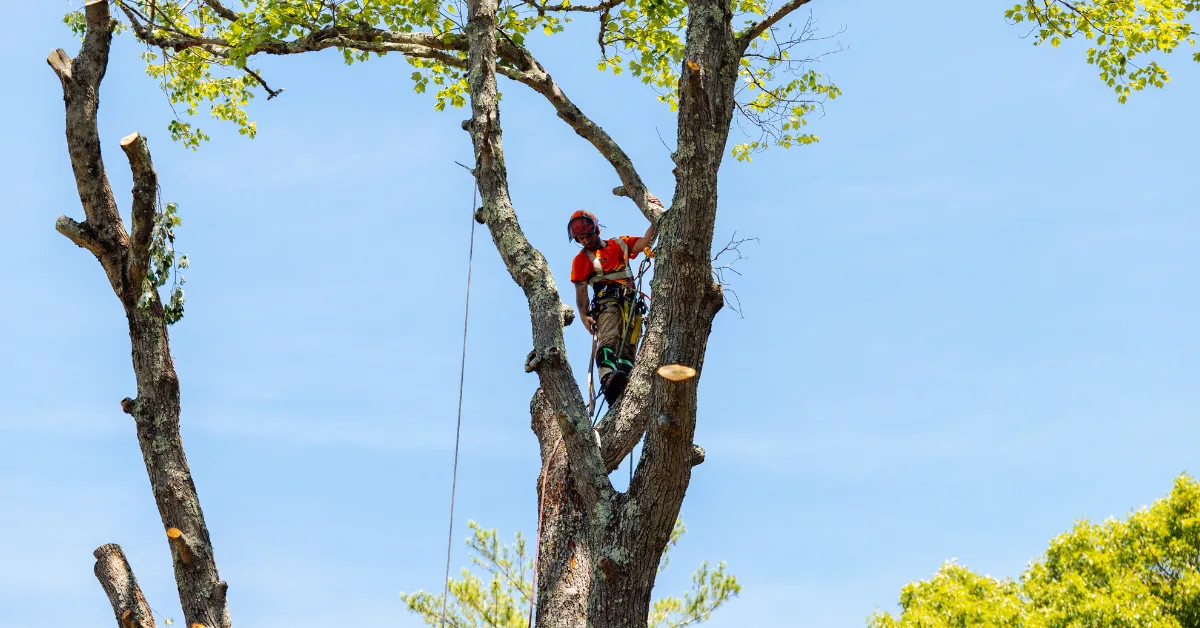
Removing a large or unstable tree can be dangerous, especially when it is near a house, fence, driveway, septic area, or utility lines. Professional crews plan the removal, choose suitable equipment, and control how sections are lowered or lifted.
Denison Tree Removal serves communities across the region. You can check the company’s Connecticut tree service areas or review a local example. For trees that are close to structures or difficult to access, a site assessment helps determine the safest approach.
If you are unsure whether a tree is hazardous, do not climb it, cut major limbs, or operate a chainsaw near a damaged trunk. Keep people away from the area until it has been assessed.